
Introduction: Not All Concrete Is Created Equal
Concrete is the most widely used construction material inthe world, but not all concrete is the same. Ask any builder what goes into a strongbuilding and you’ll hear: “Good concrete.” But here’s the catch: the concreteunder a garden path and the concrete inside a 50-storey tower are notthe same thing.
Think of it like cooking rice. You wouldn’t use the samerecipe for a plain home meal and a wedding feast. Concrete works the same way.Builders change the “recipe” depending on how much weight the structure has tocarry.
Choosing the wrong grade can mean wasted money (a grade thatis too high) or structural risk (a grade that is too low). This guide explainswhat each grade means, its mix ratio, where it is used and how to pick theright one.
What Does “M” Mean in Concrete Grades?
In concrete grading, “M” stands for “Mix” and thenumber is the characteristic compressive strength of the concrete in N/mm²(MPa) after 28 days of curing, tested on a 150 mm cube.
In India, grades are specified under IS 456:2000(Plain and Reinforced Concrete: Code of Practice), and mix design follows IS10262. Strength is checked using the cube test on site.
Two Ways of Making Concrete
Before we meet each grade, one quick idea:
*M10, M15 and M20 are commonly made as nominal mixes. M50and M60 must always be design mixes prepared with careful materialselection and testing. Think of nominal mix as home cooking, and design mix asa chef’s precisely tested recipe.*
M10 Concrete: The Humble Base
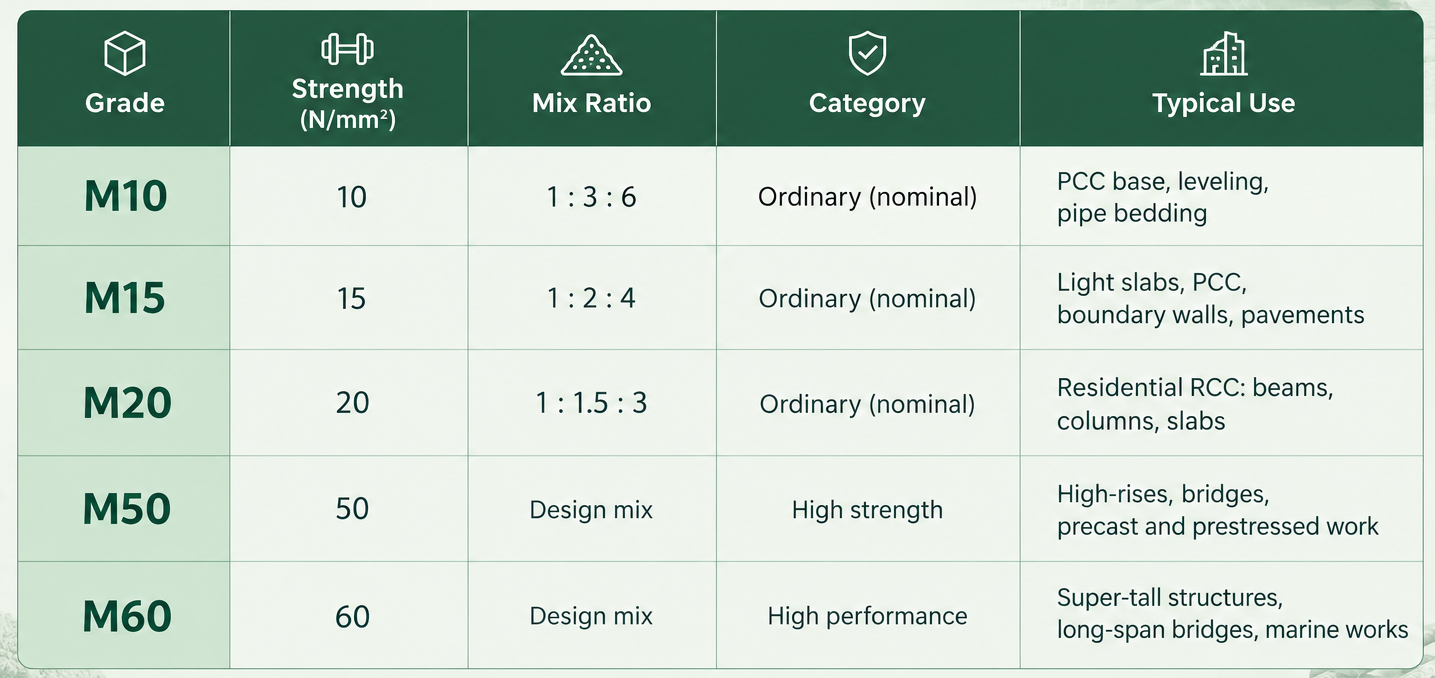
Strength: 10 N/mm² | Mix ratio: 1 : 3 : 6 (cement : sand: stone)
M10 is a lean, low-strength mix. It is the “foundation’s foundation.” It’s not meant to carry heavy loads. Instead, it creates a clean, flat, solid layer to build on, like laying a clean tablecloth before setting the table.
Common applications:
Key point: M10 is usually laid as a clean, flatworking surface before reinforcement is placed. It is rarely used forreinforced elements.
M15 Concrete: The Light-Duty Worker
Strength: 15 N/mm² | Mix ratio: 1 : 2 : 4
M15 is a bit stronger and perfect for jobs where there’s noheavy structural load. M15 is a step up from M10 and works well for light,non-structural or lightly loaded work.
Common applications:
Key point: Many small residential projects use M15for PCC and non-reinforced work, but it is generally not recommended forreinforced structural members under IS 456.
M20 Concrete: The Everyday Hero
Strength: 20 N/mm² | Mix ratio: 1 : 1.5 : 3
M20 is the most common structural grade in residential construction. IS 456 sets M20 as the minimum grade for reinforced concrete (RCC) in mild exposure conditions. If concrete grades had a star player for home building, it would be M20.
Common applications:
Key point: For buildings in moderate to severeexposure (coastal areas, industrial zones, soil with high sulphate content),higher grades such as M25 or M30 are required for durability.
Going Big: High-Strength Concrete
M10 to M20 handle everyday jobs. But for skyscrapers, long bridges and heavy infrastructure, we need serious muscle. That’s where M50 and M60 come in.
M50 Concrete: Built for Big Projects
Strength: 50 N/mm² (that’s 2.5 times strongerthan M20) | Mix: Design mix only
M50 is a high-strength structural concrete. It is produced through lab-tested design mixes using low water-cement ratios(typically around 0.35 to 0.40), good-quality cement, hard well-graded aggregates and chemical admixtures such as super plasticizers. Supplementary materials like fly ash, GGBS or silica fume are often added to boost strength and durability.
Common applications:
Benefits:
Considerations: M50 needs skilled labor, a controlledbatching plant (ready-mix concrete is typical), careful placing and thoroughcuring. Costs are higher than ordinary grades.
M60 Concrete: The Heavyweight Champion
Strength: 60 N/mm² (3 times stronger than M20) | Mix:Design mix only (high-performance concrete)
M60 sits in the high-strength concrete category. M60is concrete at its most advanced. It uses very little water, plenty ofcementitious material, silica fume and powerful water-reducing admixtures. Theresult is dense, tough concrete that’s very hard for water or chemicals to getinto.
Common applications:
Benefits:
Considerations: M60 is sensitive to errors inbatching, mixing and curing. It can also develop higher heat of hydration andshrinkage, so thermal control and proper curing are essential.
Quick Comparison Chart
How to Choose the Right Concrete Grade
Consider the load:
Light, non-structural work suits M10 or M15, while standard RCC suits M20 and above. Heavy or tall structures call for M50 or M60.
Check exposure conditions:
IS 456 prescribes minimum grades for mild, moderate, severe, very severe and extreme exposure. Coastal, industrial and marine sites need higher grades.
Follow the structural engineer’s design:
The grade should always come from the structural drawings, not guesswork.
Balance budget and performance:
Higher grades cost more, so use them only where the design requires them.
Ensure quality control:
Even the right grade fails without proper batching, compaction and curing.
Factors That Affect Concrete Strength
Water-cement ratio:
Less water generally means higher strength, provided the mix stays workable.
Quality of cement and aggregates:
Clean, well-graded, hard aggregates give better results.
Admixtures and supplementary materials:
Superplasticizers, fly ash, GGBS and silica fume improve strength and durability.
Compaction:
Poorly compacted concrete has voids that weaken it.
Curing:
Concrete needs moisture and suitable temperature for gain in strength, usually at least 7 days, with longer periods for blended cements and high grades.
Frequently Asked Questions
Which concrete grade is best for house construction? M20 is the minimum for RCC in residential buildings under mild exposure. Manyengineers prefer M25 for added durability.
Can M15 be used for slabs and columns? M15 is not recommended for reinforced structural members. Use it for PCC,flooring and non-structural work.
What is the mix ratio of M50 and M60? There is no fixed ratio. They are design mixes developed through lab trialsbased on available materials.
Is M60 concrete stronger than M50? Yes. M60 reaches 60 N/mm² at 28 days versus 50 N/mm² for M50, and is typicallyused where very high strength and durability are required.
How is concrete grade tested on site? By casting 150 mm cubes, curing them for 28 days and testing them in acompression testing machine.
Final Thoughts
From the simple M10 under a foundation to the mighty M60 in a landmark tower, every concrete grade has its own job. The secret to a strong, long-lasting building isn’t always using the strongest concrete. It’s using the right one, mixed well and cured properly.
Planning a project and not sure which grade you need? Our team of experts can guide you. Contact us today for reliable, quality-tested concrete for your next project in the exact grade your project requires.